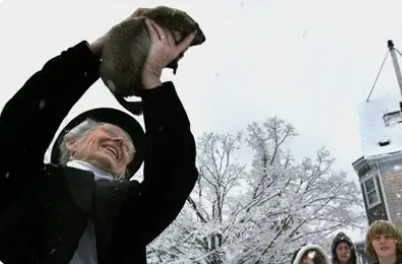
Groundhog Day is a popular North American tradition celebrated every year on February 2. It involves a groundhog (a type of marmot) emerging from its burrow to “predict” the remaining winter weather.
If the groundhog sees its shadow (typically on a sunny day), it gets scared and returns to its burrow → predicting six more weeks of winter.
If it does not see its shadow (cloudy or overcast day), it stays out → signaling an early spring.
This folklore originated from European customs, particularly German traditions tied to Candlemas (a Christian holiday on February 2), where clear weather was thought to mean a longer winter. German immigrants in Pennsylvania adapted it, swapping hedgehogs for the more common local groundhogs.
The modern American version began in Punxsutawney, Pennsylvania, with the first official observance in 1887 by the Punxsutawney Groundhog Club. It’s now a major event there at Gobbler’s Knob, drawing thousands of spectators (grounds open early, around 3:30 a.m. ET, with the prediction usually around 7:25 a.m. ET).
Punxsutawney Phil is the most famous prognosticating groundhog. As of early February 2026 (with the event on Monday, February 2):
The prediction happens live at Gobbler’s Knob, often streamed online via the official site (groundhog.org).
Forecasts suggested partly sunny to cloudy conditions with possible flurries, making a “no shadow” (early spring) outcome more likely, though the final call comes from Phil and his Inner Circle handlers.
Phil’s accuracy is famously low (around 39-40% historically), but the fun is in the spectacle! Other groundhogs like Staten Island Chuck or Buckeye Chuck make their own predictions too.
Discover more from TomT2.0
Subscribe to get the latest posts sent to your email.
 TomT2.0