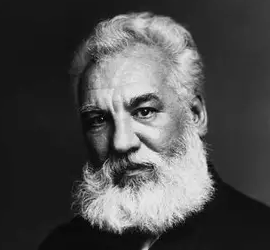
Every major invention has a moment when history shifts—sometimes loudly, sometimes quietly, and sometimes with a simple sentence spoken into a strange new machine. On March 10, 1876, that moment arrived when Alexander Graham Bell leaned over his experimental device and spoke the words that would echo across generations:
“Mr. Watson, come here, I want to see you.”
With that single line, Bell wasn’t just calling his assistant in the next room. He was calling the future.
Bell and his assistant Thomas Watson had been working tirelessly on a device that could transmit the human voice over electrical wires. At the time, this idea sounded almost impossible. The telegraph existed, but it could only send dots and dashes. The human voice—its tone, emotion, and nuance—was something entirely different.
Their workshop was cluttered with wires, coils, magnets, and the kind of improvised equipment that only true inventors can make sense of. And then, on March 10, 1876, everything came together.
Watson heard Bell’s voice clearly through the receiver. Not a buzz. Not a garbled sound. A real sentence.
In that moment, the telephone was born.
It’s hard to overstate how revolutionary that first call was. Before the telephone, communication over distance was slow, limited, and impersonal. After the telephone, the world began shrinking families could stay connected, businesses could operate faster, and news could travel instantly.
Bell’s invention set off a chain reaction that eventually led to switchboards, long‑distance calling, rotary phones, cordless phones, cell phones, and the smartphones we carry today. Every device we use now traces its lineage back to that one sentence spoken in a small workshop.
We live in a world where communication is effortless. We text, call, video chat, and send messages across the globe in seconds. But it all started with a simple experiment and two men who believed the human voice could travel through a wire.
Bell didn’t just invent a device—he opened the door to a new era. His first call marked the beginning of modern communication, shaping how we connect, work, and live.
“Mr. Watson, come here, I want to see you.”
It’s a short sentence, but it carries the weight of a technological revolution. It reminds us that history often turns on small moments—moments that don’t feel monumental at the time but end up changing the world.
Discover more from TomT2.0
Subscribe to get the latest posts sent to your email.
 TomT2.0